
Every UPS promises backup power. The differences that matter are how it behaves when the power is merely bad rather than gone, how much load it can actually carry, and whether it fits the cabinet you have.
The three topologies
Standby
The cheapest type, found under desks. It runs equipment straight from the wall and flips to battery when the power fails. Fine for a single PC, out of place in a rack, and rarely offered in rack form.
Line-interactive with AVR
The standard choice for network closets. It adds automatic voltage regulation, which corrects sags and surges using transformer taps instead of dropping to battery. That matters in older buildings and at the end of long rural feeders, where slightly low voltage is constant. The battery is saved for real outages, so it lasts longer.
Nearly everything in our rackmount UPS range is line-interactive, because it covers switches, firewalls, recorders and small servers well.
Online double-conversion
Power runs through the rectifier and inverter continuously, so the load never sees the incoming waveform at all. There's no transfer time, and frequency stays steady. That suits sensitive equipment, sites with generators, and anywhere power quality is genuinely poor. It costs more, runs warmer and uses more electricity, so buy it because the site needs it, not on principle.
Sine wave versus simulated sine wave
Cheaper units output a stepped approximation of a sine wave on battery. Modern power supplies with active power factor correction, which includes most servers, newer NAS boxes and many PoE switches, can refuse to run on that, shutting down the moment the UPS switches over. The unit tests fine on the bench and fails during the outage.
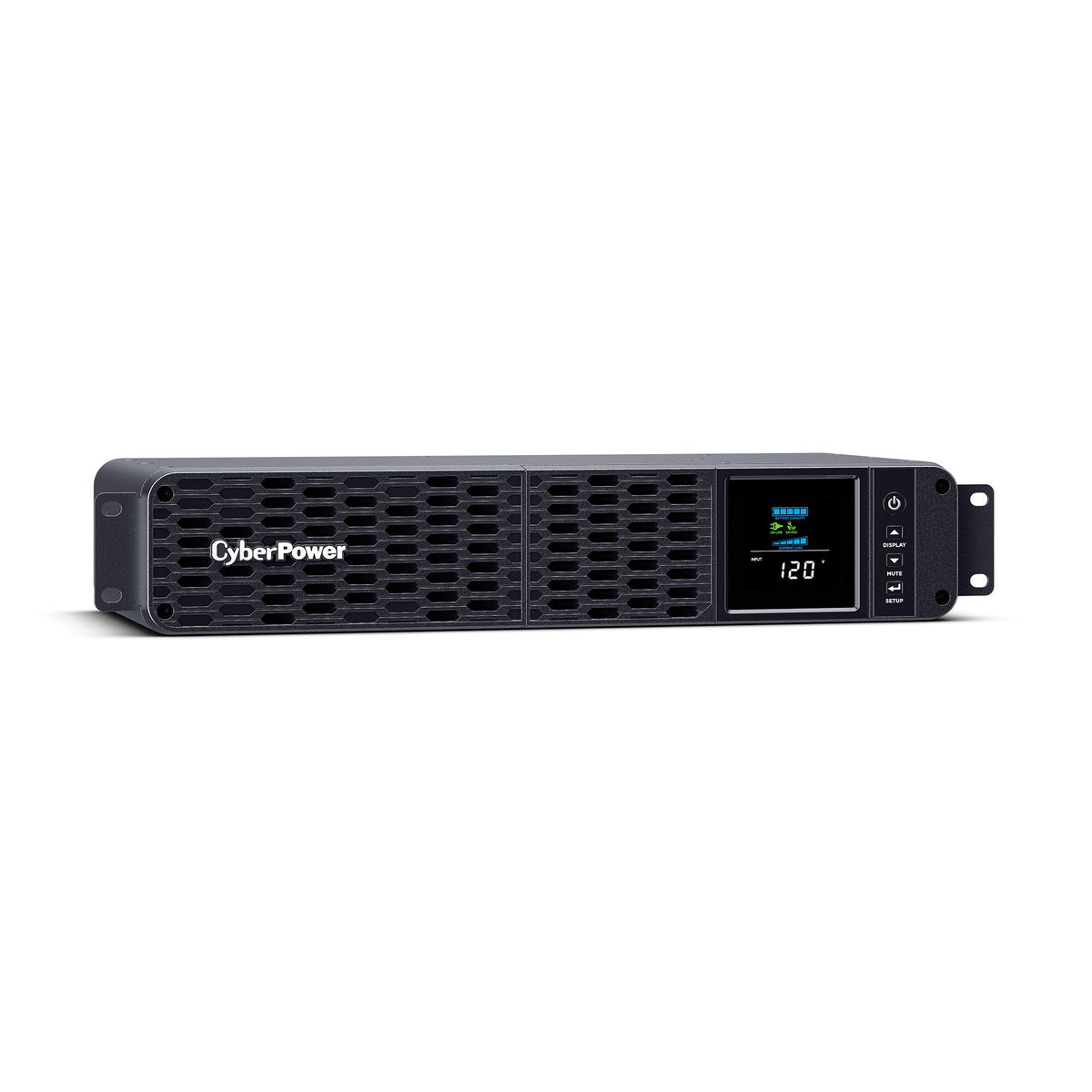
If the load includes anything with an active PFC supply, choose a pure sine wave model, such as the CyberPower CP1500PFCRM2U. It's the single most common cause of "the UPS didn't work."
VA and watts: size by watts
A UPS lists two numbers, such as 1500VA / 1000W. Watts is the real limit, and it's the number to size against. Add up the wattage of everything you'll plug in, and keep the total at or below 80% of the UPS rating so there's headroom and the runtime estimate means something.
| Typical rack load | Rough draw |
|---|---|
| 24-port PoE switch, moderate use | 150–250W |
| Small firewall or router | 20–40W |
| NVR with four drives | 60–120W |
| 1U entry server | 150–300W |
PoE is the number that surprises people. A switch's plate rating covers a full PoE budget, so check what's actually connected before assuming the worst case.
Runtime, honestly
Most rack UPS units are built for minutes, not hours: long enough to ride out a blink and shut things down cleanly. If you need a site to stay up for an hour, you're looking at extended battery modules or a generator, not a bigger UPS.
Runtime also falls as the load rises, and it falls with battery age. Plan on replacing batteries every three to five years, sooner in a hot closet.
Fitting it in the rack
- Rack spaces. 1U units suit shallow wall cabinets where spaces are scarce; 2U units carry more load.
- Depth and weight. A 1500VA UPS weighs 40 to 75 lb, and a shallow wall-mount cabinet may not take it. Check depth and the cabinet's weight rating, and mount it at the bottom.
- Outlets. Count what's plugging in. Some 1U units have as few as six.
- Network card. Without one, nobody learns about a failed self-test. Some units include it, like the APC SMT1500RM2UC with SmartConnect; others take an optional card.
Don't skip the shutdown software
A UPS that keeps servers running for eight minutes and then drops them mid-write has only delayed the damage. Install the manufacturer's agent, or point your hypervisor at the UPS, so equipment shuts down cleanly with battery to spare.
Picking one
| Site | Sensible choice | From our range |
|---|---|---|
| Small closet: switch, firewall, modem | 1U line-interactive, 1000VA class | CyberPower OR1000LCDRM1U |
| Busy closet: PoE switch, NVR, small server | 2U line-interactive, 1500VA class, pure sine wave | CyberPower CP1500PFCRM2U |
| Poor power, generator, sensitive gear | Online double-conversion | Ask us for a quote |
Email support@rackit.com with the equipment list and we'll size it properly, including the PoE budget you actually use. Browse rackmount UPS units.